A practical, no-spin guide to deciding whether professional duct cleaning is right for your home.
Key Takeaways (TL;DR)
- Air duct cleaning is worth it when there is a real reason for it, such as visible mold growth, a rodent infestation, heavy dust buildup, or a recent home renovation. It is rarely worth it as a blind, do-it-every-year ritual.
- The EPA does not recommend cleaning ducts on a fixed schedule. It recommends cleaning "as needed." (US EPA guidance)
- NADCA, the industry standards body, suggests every 3 to 5 years as preventive maintenance for most homes.
- Tampa's climate tips the scale. High humidity, long pollen seasons, and warm temperatures make moisture and mold a bigger factor here than in drier parts of the country.
- Typical air duct cleaning cost runs about $300 to $700 nationally in 2026, though many local Tampa companies use flat promotional pricing well below that. Watch out for offers that look too cheap to be true.
- The single most important decision is who you hire. A careful, transparent duct cleaning service provider is worth far more than the lowest bidder.
The Short Answer
For most Tampa homeowners, air duct cleaning is worth it when there is a specific trigger, and a poor use of money when there is not.
That is the honest version. It is also the version that lines up with what the country's two main authorities actually say, even though they emphasize different things.
The rest of this guide explains how to tell which camp your home falls into, what to expect to pay, and how to avoid the duct cleaning scams that give this service a bad name.
What the Experts Actually Say (EPA vs. NADCA)
Homeowners get confused here because the two leading voices sound like they disagree. They mostly do not. They are answering different questions.

The EPA: clean "as needed," not on a schedule
The U.S. Environmental Protection Agency takes a conservative position. The US EPA does not recommend routine air duct cleaning, and notes that cleaning has never been proven to prevent health problems on its own. Much of the dust in ducts sticks to the surfaces and does not circulate into your living space. (Read the EPA's full position)
The EPA does, however, recommend cleaning when there is a clear reason: visible mold growth, a rodent infestation, or clogged ducts where debris is actually blowing into your rooms.
NADCA: every 3 to 5 years as maintenance
The National Air Duct Cleaners Association (NADCA) sets the technical standards for the cleaning industry. Its guidance is to clean every 3 to 5 years, with the logic that removing accumulated dust takes away the "fuel source" before mold or duct contamination becomes a problem.
How to read the gap
Think of it this way. The EPA is asking, "Has cleaning been proven to make people healthier?" The honest answer is "not conclusively." NADCA is asking, "Is it sensible home maintenance?" The honest answer there is "often, yes."
Both can be true at once. Your job is to figure out which logic applies to your specific home, which is where Tampa comes in.
Why Tampa Changes the Math
This is the part most national articles skip, and it matters more than almost anything else on this page.
Tampa's subtropical climate creates conditions in which the EPA's "as needed" triggers show up far more often than they do up north.
- Humidity is the big one. Indoor relative humidity above roughly 60% turns an HVAC system into a comfortable home for mold spores. The widely cited target range for a healthy home is about 45% to 55%.
- Condensation forms inside ducts. Warm, moist air meeting cool surfaces can leave moisture behind in the ductwork, on the cooling coils, and in the condensate drain pans, which can lead to mold growth or rust over time.
- The pollen season is long. Central Florida's extended growing season pushes more allergens and dust particles into homes through doors, windows, and any leaks in the system.
- Indoor air is often dirtier than outdoor air. The EPA notes indoor air can be 2 to 5 times more polluted than the air outside, and a humid, sealed home concentrates that. Over time, poor indoor air quality is linked to what is sometimes called sick building syndrome, where occupants report headaches, fatigue, or respiratory issues tied to the building itself.
So while a homeowner in a dry climate might reasonably skip duct cleaning for a decade, a Tampa Bay home with musty odors, recent water intrusion, or visible mold has a genuine, climate-driven reason to look closer.
If moisture and mold are your real concern, the fix is often broader than the ducts alone. It can include humidity control, duct sealing to stop leaks, and targeted mold remediation, not just a vacuum down the vents.
Signs You Actually Need Air Duct Cleaning
Here is the practical checklist. If one or more of these is true, professional duct cleaning is likely worth it. If none are true, you can probably wait.
- Visible mold growth inside the ducts, on registers, or around the air handling unit housing.
- Persistent musty odors or a "dirty sock" smell when the HVAC system or fan runs.
- Evidence of a rodent infestation such as droppings, nesting material, or debris blown out of vents.
- A recent home renovation especially drywall sanding, that sent dust into an uncovered system.
- Heavy dust buildup on vent covers and surfaces right after you clean them, along with visible pet hair and pet dander.
- Allergy symptoms or respiratory issues that get noticeably worse indoors and ease when you leave, sometimes felt as unexplained allergies.
- The system has never been cleaned and is well past the 3-to-5-year window, particularly in an older Tampa home.
Important nuance: if you see mold, the goal is not just cleaning but removing the moisture source. Otherwise it comes back. A reputable provider will say so.

Types of Duct and Air Services (and What They Are For)
"Duct cleaning" is often a bundle of related services. Knowing the difference helps you avoid paying for things you do not need, and recognizing the ones you do.
- Air duct cleaning: Removing dust, debris, and contaminants from the supply and return ductwork that carries conditioned air through your home, restoring airflow.
- Dryer vent cleaning: Clearing lint from the dryer's exhaust line. This is primarily a fire-safety service, and it is genuinely worth it on a regular basis.
- AC coil cleaning: Cleaning the cooling coils and condenser so the system runs efficiently. The EPA notes that cleaning components like coils and heat exchangers can improve system performance, more so than cleaning ducts alone. See AC coil cleaning.
- HVAC sanitization: Treating the interior of the system to address microbial growth, often paired with cleaning in humid climates. See HVAC sanitization.
- Mold remediation: A separate, more involved process for actual mold problems, which goes well beyond surface cleaning.
- UV light installation: A UV-C lamp installed in the system to limit mold and bacteria growth on coils, a popular add-on in Florida homes.
A full menu of these is outlined on the services overview, which is a useful reference if you are not sure which problem you are actually solving.
What a Proper Duct Cleaning Process Looks Like
Not all cleaning is equal, and the method is where cheap operators cut corners.
A thorough duct cleaning process follows what the industry calls source-removal cleaning. The technician places the system under negative air pressure and physically dislodges debris so it is captured rather than scattered back into your home.
A complete job reaches the whole system, not just the vents you can see. That means the supply and return ducts, the air plenum, the blower motor, the cooling coils and heat exchangers, the condensate drain pans, and the air handling unit housing.
If a company is in and out in twenty minutes with a shop vacuum, that is not a real cleaning. It is a sales call.
What Does Air Duct Cleaning Cost?
National pricing gives you a sane baseline so you can spot both overcharging and suspiciously cheap bait pricing.
| Pricing model | Typical 2026 range | Notes |
|---|---|---|
| Whole-home (flat) | $300 to $700 (US average) | EPA and NADCA references cite $450 to $1,000 for larger homes |
| Florida metro | $270 to $500 | Often lower than the national midpoint |
| Per supply vent | $25 to $50 per vent | Multiply by your vent count for a rough estimate |
| Per square foot | $0.15 to $0.40 | Larger homes pay more |
| Dryer vent only | $89 to $250 | Often offered as a standalone or add-on |
Figures reflect 2026 market data and vary by home size, system count, accessibility, and contamination level. Always confirm a written quote.
Many Tampa companies advertise simple flat rates rather than per-vent math. That is normal and can be a great deal, so compare transparent local pricing before you commit. The thing to watch is the difference between an honest flat rate and a teaser price designed to get a technician in the door who then "discovers" expensive add-ons. Ask up front what the air duct cleaning cost includes and what would trigger an upcharge.

The Real Benefits (and the Honest Limits)
What you can reasonably expect:
- A smaller allergen reservoir. Removing settled dust, pet hair, pet dander, and spores lowers the pool of material that can become airborne, which supports allergy relief and, for some households, allergy and asthma relief.
- Odor removal. Clearing musty buildup and biological growth often removes that stale smell, a common Tampa complaint.
- Better airflow and energy efficiency. Cleaner components, especially the cooling coils, can help the system breathe and run as designed, which can ease pressure on your energy bills.
- A longer air conditioner lifespan. Less strain on a clean system, plus the chance to catch leaks or damage early, can extend the equipment's working life.
- A free inspection of your system. A good cleaning visit doubles as a check for hidden moisture or duct contamination you would not otherwise see.
What it will not reliably do:
- It is not a proven cure for medical conditions, and the EPA is clear that health benefits are not conclusively demonstrated.
- It will not fix a humidity or mold problem at the source. That needs moisture control and possibly duct sealing.
- Clean ducts alone will not dramatically slash your energy bills. Coil and overall system efficiency matter more there.
Setting honest expectations is the point. Worth it does not mean miraculous.

DIY vs. Professional: A Quick Comparison
| Factor | DIY mindset (vacuum and vent covers) | Professional duct cleaning |
|---|---|---|
| Cost | Near zero | $300 to $700 typical |
| Reach | Surface and a few inches in | Deep into the full duct run |
| Equipment | Household vacuum | Negative air pressure machines, brushes, cameras |
| Mold handling | Not recommended | Proper containment and treatment |
| Best for | Light home maintenance, vent covers | Real triggers: mold, pests, post-renovation, clogged ducts |
For routine upkeep, wiping vent covers and changing your air filters (a MERV 8 to 13 filter is commonly recommended for Tampa homes) does a lot of the work. For an actual problem, the equipment gap is the reason professionals exist.
How to Choose a Provider Without Getting Burned
Because results depend almost entirely on who shows up, this is the section that saves you money.
- Check for certification and experience. Look for NADCA-aligned training and a track record with systems like yours.
- Demand transparent pricing. A clear, written quote with the scope spelled out. Be skeptical of prices that seem impossibly low.
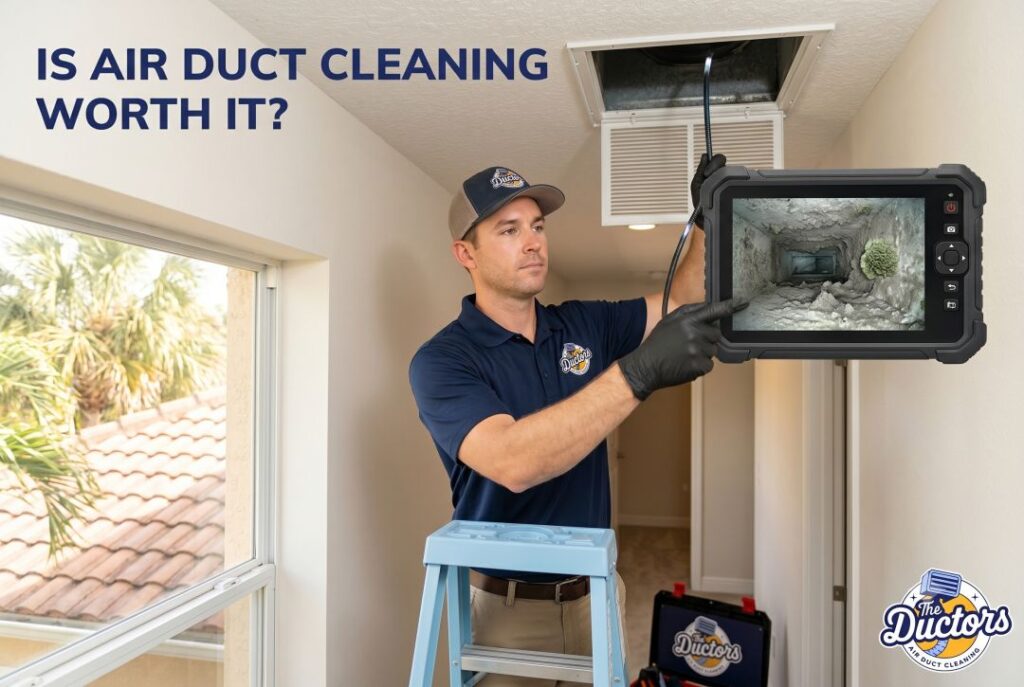
- Ask for before-and-after proof. Reputable companies document the work with photos or video.
- Read independent reviews. Patterns across many reviews tell you more than any single testimonial.
- Confirm they are licensed and insured. Non-negotiable in Florida. Avoid cheap or unlicensed duct cleaners whose low price often hides a bait-and-switch.
- Watch the biocide push. If a company insists on spraying chemical biocides inside your ducts, ask why. The EPA urges caution. If treatment is truly warranted, ask whether an EPA-approved sanitizer is being used and why it is necessary, rather than accepting it as automatic.
A few things separate the best local providers from the rest:
- Availability. The strongest companies offer same-day service options and rarely turn down a job.
- Accountability. Look for a real satisfaction guarantee, a crew confident enough to come back and re-clean if you are not happy.
- The right tools. Advanced, specialized equipment that cleans thoroughly without damaging your HVAC system, rather than improvised gear that can do more harm than good.
If you are comparing local options across the region, confirm coverage on the Tampa air duct cleaning service page.
Frequently Asked Questions
How often should I clean my air ducts in Tampa?
Most homes do well on a 3-to-5-year cycle, in line with NADCA guidance. In Tampa's humid climate, or if you have pets, allergies, or a recent home renovation, the shorter end of that range, or an as-needed approach when symptoms appear, makes sense.
Is air duct cleaning a scam?
The service itself is legitimate, but the industry has bad actors. Duct cleaning scams are usually not the cleaning itself, but the bait-and-switch pricing and unnecessary add-ons. Choose a transparent, well-reviewed, licensed duct cleaning service provider and you avoid almost all of the risk.
Will duct cleaning lower my energy bills or help my allergies?
It can help modestly with both, but do not expect miracles. Cleaner cooling coils help energy efficiency more than clean ducts do, and reducing the dust and spore reservoir can ease allergy symptoms. The EPA does not consider health benefits conclusively proven, so treat it as one helpful step, not a cure.
What if there is visible mold growth in my ducts?
Mold is one of the clearest reasons to act, especially in Florida. But cleaning alone is not enough if the moisture source remains. Pair the cleaning with humidity control and proper mold remediation so it does not simply grow back.
The Bottom Line
Is air duct cleaning worth it? It depends on your home, and in Tampa, the climate makes "yes" more common than it would be elsewhere.
Skip it as a blind annual habit. Pursue it when you have a real trigger: visible mold growth, a rodent infestation, a home renovation, persistent musty odors, or worsening allergy symptoms. And in all cases, spend your energy choosing a transparent, qualified provider rather than chasing the lowest price.
If you want to dig deeper into specific services or see local pricing, explore the full range of duct and air services or request a free consultation.
About the Author
Written by an experienced air duct and HVAC cleaning team serving Tampa and the wider Tampa Bay area, drawing on more than a decade of hands-on work. Technical guidance in this article references the U.S. Environmental Protection Agency (US EPA) and the National Air Duct Cleaners Association (NADCA). For service-specific questions, you can reach a certified technician at (813) 669-2555.
Sources referenced:
- U.S. Environmental Protection Agency, "Should You Have the Air Ducts in Your Home Cleaned?"
- National Air Duct Cleaners Association (NADCA) maintenance guidance
- 2026 national and Florida duct cleaning cost data
This article is reviewed and updated periodically to reflect current pricing and guidance. Last updated: June 2026.